
Sigma Training & Enablement
July 20, 2026
Building with Sigma + Claude
October 7, 2026Nothing Died. But It All Changed.
“The more things change, the more they stay the same.” -Jean-Baptiste Alphonse Karr, 1849
It’s funny how words from 1849 still ring true in 2026. If you’ve been working in the data & BI space for any period of time, you know that adapting to change is not a suggestion, it’s a requirement.
If you’re like me and scroll LinkedIn on a regular basis, you probably have the same impression – if you’re not using AI to automate your work/entire life, you’re behind! DON’T BE THE ONE THAT MISSES OUT!
It would be ignorant of me both as a critical thinker and a business leader to brush off AI as a foot note. I actually believe AI will eventually rival the iPhone in terms of its impact on business and the way the world operates, but…
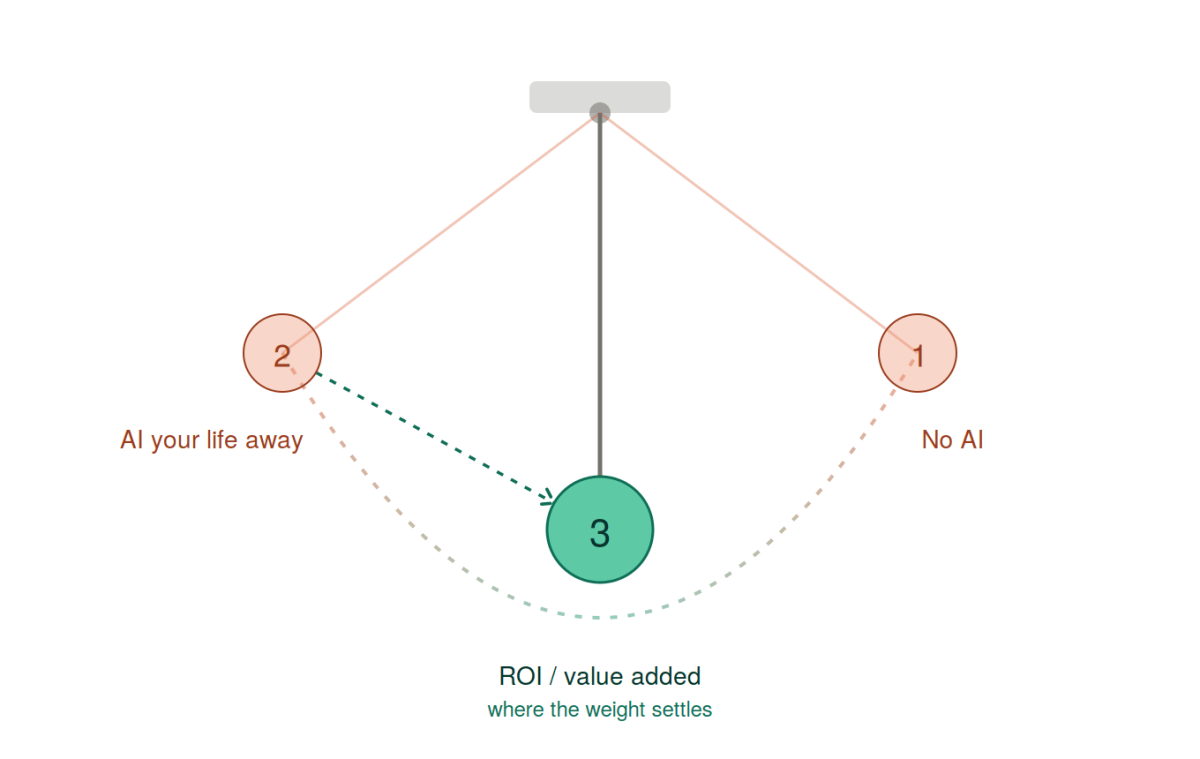
I also think that history has a way of repeating itself. With every new technology, advancement, or resource there tends to be a pendulum effect. At first, human curiosity pushes the limits of the new tool. People start figuring out what it can and cannot do.
Right now the pendulum is stuck in obsession mode, at least until pre-IPO investors cash in on their investments.
As history would allude, I think the pendulum will find its way back to the middle. We’re going to keep discovering where the value of AI is and where it isn’t.
At Maverick Data we’re having these conversations about AI, Claude, SaaS, and BI every single day. This blog is meant to be a guide on some of the common topics that we’re seeing with our clients and give our take on where things are headed.
Dashboards are dead.
Kudos to the ThoughtSpot marketing team – has there been any more eye-catching headline than the Dashboards are Dead marketing campaign circa 2021? So good.
While a great marketing tagline – we don’t think dashboards are dead.
Dashboards are still a very efficient way to answer questions that you’re going to ask on a consistent basis. Example – you do not want to replace your speedometer in your car with a chat agent. Why? Because you always want to be able to look at the same place and receive that piece of information. Imagine having to ask Claude how fast you are driving every time you check your speedometer.
Let’s take the speedometer metaphor a step further. Your check engine light coming on is an indicator that action needs to be taken. Seeing that indicator is necessary, but what you really need to understand is WHY. This is what will drive your next step.
For example, BI 3.0 platforms like Sigma let users embed AI agents natively into traditional dashboards. These agents can kick off stored procedures, run AI-driven text analysis, or write data back to your CDW, and they’re super easy to build. So instead of walking away from your dashboard to go hunt down the WHY, you can chat with an agent right there on the dashboard, understand what’s driving the number, and take action without ever leaving the view.
This is an example of where the intersection matters. BI tells you WHAT, and it always will in a deterministic (not probabilistic) manner. But the platforms that also help you get to WHY, in the same place, are the ones that will drive action and ultimately, value.
BI is dead.
Traditional BI being replaced by AI is another common conversation that we have with clients. BI is not dead – but it is rapidly changing.
To understand how we got here, we need to understand why the BI 2.0 wave of the 2010’s was so impactful. BI 1.0 (think Cognos and Business Objects) allowed users to access data. Yes, in 2008, simply getting access to your data – albeit in a spreadsheet like print out – was a huge advancement in the way that businesses operated.
By 2015, BI 2.0 enabled the everyday business user to utilize SQL via tools such as Tableau and Power BI. Yes these tools provided visualization capabilities, but the core advancement these tools enabled was not the charts, it was the ability for LOB users to have the power of SQL in a drag and drop interface.
Fast forward to 2026 – Claude can generate your SQL faster than you can think it, so that’s not necessarily a benefit anymore. The need for any platform in the BI 3.0 era is the ability for everyday LOB users to leverage AI and Agentic Workflows.
Just as Tableau/Power BI enabled business users to leverage SQL, BI 3.0 tools like Sigma are doing the same for AI Agents & Agentic Workflows. Even for seasoned data professionals, AI can be difficult to fully understand the implications of. So asking a non-technical user to fully adopt and implement AI solutioning is a big leap.
To bring this idea full circle, I think it’s important to note that even in the BI 2.0 wave, building custom web applications was always an option and had been since the 90’s. While it was certainly more costly and time intensive because Claude was not there to spit out the needed code in seconds, it was still an option for a team equipped with the right set of skills. Even so, organizations opted for centralized low-code/no-code platforms.
SaaS is dead.
Making a salad is really really easy. Chop some carrots, lettuce, chicken, mix together a little dressing, and you have a salad. In theory, a company like Sweetgreen should not exist. People really are too lazy to make themselves salads!? The answer actually isn’t tied to work ethic – it’s economics.
The economist Adam Smith spoke of economies of scale in his 1776 book Wealth of Nations. His core argument was that division of labor and specialization are the two most effective means of achieving higher levels of production.
People don’t go to Sweetgreen because they’re too lazy to make a salad. They go to Sweetgreen because they don’t like to cook, they don’t have the time to cook, their time is more valuable spent working instead of cooking, or it is more expensive to buy all the items to make the salad at home. The reality is that in a lot of scenarios it’s actually more efficient and cost effective to go to Sweetgreen than to make the salad yourself.
This argument also applies to SaaS companies in the age of Claude & AI.
For a team of experienced software engineers or data engineers – Claude is gasoline on your fire. For organizations that do not understand MCP servers, SLIs, CDW architecture, CI/CD pipelines, GitHub repos, and other software/data engineering concepts – Claude-ing your way to deliverables could be a disaster.
We see SaaS companies continuing to play a large role in how enterprise organizations analyze and distribute data. Not necessarily because the product is better, but because ultimately it will be more efficient.
In order to replace a SaaS platform you’re going to need to create governance structures, CI/CD procedures, embedded platforms to present data outside your org, standardized code templates, common data models, etc.
This type of infrastructure build is not like patching a little drywall. You’ll most certainly need to hire software engineers, data engineers, solution architects, and technical PMs. Now add in your massive token expenditures, the additional time and energy needed to maintain software applications, and eventually the cost of your DIY project makes you realize that you should have hired a contractor.
Adam Smith’s theory of labor specialization would suggest that SaaS companies will continue to add value because they can do it cheaper and more efficiently due to scale.
Power BI used to be cheap too.
Remember when Power BI was free? Those were the good old days. (Yes, I’m aware it was never actually free)
Fast forward 8 years and Microsoft is now taking the same route that every other tech company including Databricks and Snowflake have taken – charging for consumption. The license cost has gone up, but that’s not the point here. Microsoft gatekeeps all new functionality of their platform by making people transition to the Fabric platform where they are charged for consumption.
Shouldn’t be a shocker, but that will be what Anthropic eventually does with its users, even those on the more basic platforms. The reason why? Economics.
Like any company that’s trying to grab market share, emerging companies underprice their product to encourage adoption. Think Power BI and their $9.99/m/u price tag or their marketing that Power BI was “free”. The strategy was to use Power BI as a loss leader to grab market share so that they could cash in later when they raised prices and got more users into the Microsoft ecosystem. The pre-IPO AI companies are running the exact same play right now.
AI companies also have an interesting paradox at play. They need users to consume to generate revenue, but their technology has also been promised to eliminate headcount. At the same time, the cost of compute will most likely decrease with scale and technological advancements. Think iPhone cost, think TV cost. Technology has a historical trend of getting smaller, more efficient, and ultimately cheaper.
Just because compute gets cheaper doesn’t mean that they’ll charge less for it. For an industry needing to satisfy trillions of dollars in investment, I expect to see compute costs continue to decline with the price charged for consumption staying the same or increasing to improve margin and revenue.
Anyways, I’ve said enough…
To summarize…
If nothing else, it’s a fascinating time to be a data professional. Everything I write today on July 30th, 2026 might be wildly out of date and naive by January 1st, 2027 but that’s part of the fun.
Like Bob Dylan said, the times are a-changin’ and at Maverick Data we’re changing with it. As data professionals standing at the intersection of BI & AI, we’re less interested in the headlines of what’s dying next and more interested in helping our clients figure out how to maximize ROI in both their SaaS and AI platforms.
Whether you found this blog interesting, infuriating, or flat out incorrect – we’d love to connect with you and talk!
Contact Us
If you would like to talk to someone at Maverick Data about maximizing your AI & BI ROI, please email us at spencer@maverickdata.io!